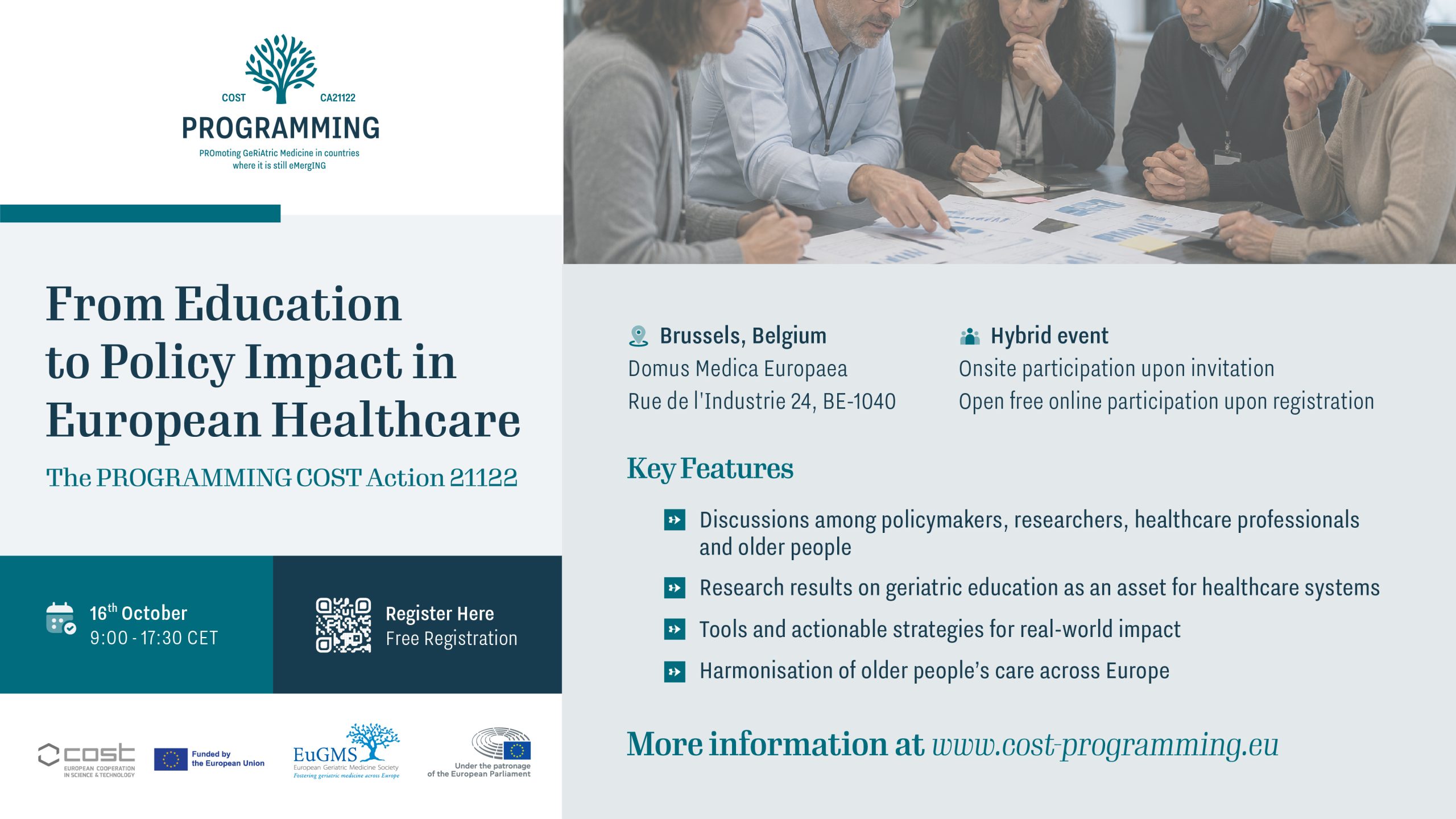
We are pleased to welcome you to the final event of the PROGRAMMING COST Action 21122, taking place in Brussels on 16th of October 2026.
This meeting will present the key outputs and legacy of the Action, while fostering a forward looking discussion on how these achievements can translate into policy and practice. Together, we will explore practical solutions to improve and harmonise standards of care for older people across Europe and highlight the importance of interprofessional education and collaboration in strengthening healthcare systems.
The event also aims to reinforce the role of Geriatric Medicine as a strategic response to population ageing, and to foster dialogue between policymakers, the scientific community, healthcare professionals, and the civil society.
We are particularly grateful to the European Geriatric Medicine Society (EuGMS), as Grant Holder and key contributor to the Action, for its continuous support. This event represents not only the conclusion of a successful collaborative effort, but also the starting point for future scientific collaborations and initiatives within the wider research and clinical community.
The event will take place event will take place in Brussels at the Domus Medica Europaea, Rue de l’Industrie 24, BE-1040 Brussels, Belgium on October 16th, 2026. Official language is English.
Streaming
Open Sessions will be streamed on zoom at the following link: https://us06web.zoom.us/meeting/register/7rrPIyDFTIGgV1MFMmzkeA
Chat function will be available for comments and questions.
Registration
Registration for the event is free for both onsite and online participation.
Even though showing up to the publicly open sessions is possible, pre-registration is strongly recommended, whether you intend to participate online or onsite.
To pre-register, please use this link to register: www.us06web.zoom.us
Following this you will receive the formal invitation via the e-COST platform that we kindly ask you to accept by clicking to the right link, to officialise your participation to the event.
Video Recordings
Most of the event’s sessions, will be videorecorded and videos will be accessible on the website and social media of the PROGRAMMING COST Action and of the EuGMS. Acceptance of the e-COST invitation implies consent for recording and appropriate
Download Program.
Press Release 1
European experts and policymakers meet in Brussels to promote more equitable healthcare for older people across Europe
How can Europe reduce inequalities in geriatric care and ensure that older people benefit from high-quality care, regardless of where they live?
Brussels, 16 October 2026
Experts in Geriatric Medicine, healthcare professionals, academicians, policymakers and representatives of civil society will meet in Brussels on 16 October 2026 for the final event of PROGRAMMING COST Action 21122 – PROmoting GeRiAtric Medicine in countries where it is still eMergING to discuss how Europe can reduce inequalities in healthcare for older adults and strengthen access to geriatric expertise across healthcare systems.
Entitled “From Education to Policy Impact in European Healthcare”, the meeting will take place at Domus Medica Europaea, Brussels, and will bring four years of international collaboration to a close, while looking ahead to how the knowledge, educational resources and tools developed by PROGRAMMING can be translated into healthcare policy and clinical practice. The event is held under the patronage of the European Parliament, underscoring the European dimension of the challenges addressed by PROGRAMMING and the importance of improving care for older adults across Europe.
At the centre of the discussion is a major challenge facing European healthcare: despite major advances in healthcare, many older adults still receive healthcare that is not adequately adapted to their needs. Differences in the recognition of Geriatric Medicine as a specialty, as well as in healthcare professionals’ training in geriatric competencies and access to geriatric expertise, contribute to this heterogeneity. At the same time, many healthcare systems remain insufficiently prepared to address the specific and complex care needs of older adults. As Europe’s population continues to age, addressing these challenges is increasingly important for both the sustainability of healthcare systems and equity in healthcare. By 2050, nearly one-third of the European population will be aged 65 years or older, increasing the need for healthcare systems that are equipped to respond to the complex needs of older adults.
PROGRAMMING is a European initiative aimed at strengthening education and training in core principles of care for older people, particularly in countries where the field is still developing. The main outputs of PROGRAMMING will be presented, including the identified educational needs of healthcare professionals in the core principles of geriatric care and, based on these needs, a proposed framework and content for educational activities across different healthcare settings, i.e. primary, home, acute, subacute and long-term care.
However, the meeting in Brussels will move beyond education alone. Dedicated panels will discuss how high-level strategies can be translated into national policies and how scientific collaboration and civil society can contribute to advocating for quality care for older adults. Moreover, as high-quality care for older adults requires an interprofessional approach, the programme will highlight the importance of extending geriatric education beyond Geriatric Medicine specialists to doctors from other medical specialties, nurses and allied healthcare professionals.
The meeting will bring together experts from different European countries and institutions, such as World Health Organization (WHO), European Cooperation in Science and Technology (COST), European Geriatric Medicine Society (EuGMS), International Association of Gerontology and Geriatrics (IAGG), Age Europe and European Patients’ forum, as well as numerous experts involved in PROGRAMMING COST Action 21122 and in national health authorities from several European countries.
“As PROGRAMMING COST Action comes to its end, it is time to leverage its scientific outputs and impact and to reinforce the role of Geriatric Medicine as a strategic response to population ageing across all European countries. The next step is to translate the fruits of this European collaboration to clinical practice and sustainable policy”, says Marina Kotsani, Chair of PROGRAMMING COST Action 21122.
About PROGRAMMING COST Action 21122 (PROmoting GeRiAtric Medicine in countries where it is still eMergING): PROGRAMMING is a European research and networking initiative supported by COST (European Cooperation in Science and Technology). It aims to strengthen education, training and capacity building in Geriatric Medicine, particularly in countries where the discipline is still emerging. https://cost-programming.eu/
About European Geriatric Medicine Society (EuGMS). It is a European professional society dedicated to advancing Geriatric Medicine through education, research, and collaboration, in order to improve healthcare for older adults. It is the Grant Holder of PROGRAMMING, has been a key contributor throughout the Action, and will continue to serve as the main platform for the continuation and further development of the initiatives launched through the Action.
Event information
From Education to Policy Impact in European Healthcare: The PROGRAMMING COST Action 21122
16 October 2026 | 09:00–17:30 CEST
Domus Medica Europaea, Rue de l’Industrie/ Nijverheidstraat 24, BE-1040 Brussels, Belgium
The event will be held in a hybrid format, and the sessions will be streamed on zoom at the following link: https://us06web.zoom.us/meeting/register/7rrPIyDFTIGgV1MFMmzkeA .
Onsite attendance does not require prior registration. However, due to the venue’s maximum onsite capacity and the fact that the event is fully booked, onsite access for media representatives can only be guaranteed between 17:30 and 18:30 CET.
The official language of the event is English.
Press Release 2
European experts call for stronger integration of Geriatric Medicine into healthcare policies to reduce inequalities in care for older people
Brussels, 23 October 2026 – Improving healthcare for older people requires more than acknowledging population ageing. It demands concrete action to strengthen Geriatric Medicine, equip healthcare professionals with appropriate competencies and ensure that older people have access to high-quality, person-centred care, regardless of where they live.
This was a central message emerging from the final meeting of PROGRAMMING COST Action 21122 – PROmoting GeRiAtric Medicine in countries where it is still eMergING, held on 16 October at Domus Medica Europaea, Brussels, under the patronage of the European Parliament.
Entitled “From Education to Policy Impact in European Healthcare”, the event brought together experts in Geriatric Medicine, healthcare professionals, representatives of international and European organisations, national health authorities and civil society to discuss how four years of European scientific collaboration can contribute to improving healthcare policies and clinical practice.
From scientific evidence to healthcare policy
Despite Europe’s ageing population, access to geriatric expertise and training remains uneven across countries. Differences in the recognition and development of Geriatric Medicine as a medical specialty, together with gaps in geriatric competencies across the wider healthcare workforce, contribute to inequalities in the care available to older people.
A policy-focused panel, bringing together representatives of the World Health Organization (WHO), the European Observatory on Health Systems and Policies, AGE Platform Europe, COST, national healthcare organisations and civil society, explored how scientific evidence can be translated into concrete healthcare policies.
The discussion highlighted the need to position Geriatric Medicine within broader health system reforms, including efforts to strengthen primary and community care, improve long-term care and ensure the sustainability of healthcare systems. Participants also emphasised that inequalities in access to appropriate healthcare for older people raise fundamental questions of equity, human rights and age discrimination.
Importantly, the panel identified practical opportunities to bring geriatric expertise into European and national policy discussions, including ongoing healthcare reform processes and forthcoming European initiatives on care. It also underlined the importance of adapting scientific evidence to national contexts, engaging directly with policymakers and building alliances with civil society and organisations representing older people.
The discussions pointed to the need for policymakers and health authorities to recognise the contribution of Geriatric Medicine in health workforce planning, support the integration of geriatric competencies into undergraduate and postgraduate education and continuing professional development, and strengthen coordination between health, primary care, community services and long-term care. Translating these priorities into national strategies and implementation plans will be essential to reducing inequalities in care for older people.
“Over the past four years, PROGRAMMING has brought together expertise from across Europe to identify educational gaps and develop resources to help address them. But producing scientific evidence and educational tools is only the first step. Our next challenge is to ensure that this work reaches those responsible for healthcare education, organisation and policy, so that older people can benefit from more equitable, high-quality care across Europe.” says Marina Kotsani, Chair of PROGRAMMING COST Action 21122.
Four years of collaboration provide tools for change
The meeting presented PROGRAMMING’s main outputs: a mapping of Geriatric Medicine education across Europe, an assessment of healthcare professionals’ educational needs and proposed educational frameworks and content for different care settings, including primary and home care to acute and subacute, and long-term care.
The Action also developed advocacy resources aimed at communicating the relevance of Geriatric Medicine to healthcare professionals, educators, civil society and policymakers.
A further outcome is the PROGRAMMING Toolkit, designed to facilitate access to the Action’s outputs and support their future use and adaptation by healthcare professionals, educational institutions, professional organisations and other stakeholders.
Together, these resources provide a foundation for translating scientific knowledge into practice, developing educational initiatives, supporting collaboration and informing efforts to strengthen geriatric care in countries where the specialty remains insufficiently developed.
Geriatric expertise must extend across healthcare professions
A second panel focused on the importance of interprofessional collaboration in caring for older people with complex healthcare needs.
Participants highlighted the complementary roles of Geriatric Medicine specialists, doctors from other specialties, general practitioners and family physicians, dentists, nurses and allied healthcare professionals. They also discussed the need to integrate geriatric competencies into professional education and continuing training across different healthcare settings.
The discussions reinforced that developing Geriatric Medicine as a medical specialty and improving geriatric competencies throughout the healthcare workforce are mutually reinforcing priorities. Effective care for older people requires both specialist expertise and professionals who are equipped to recognise complex needs, collaborate across disciplines and deliver coordinated, person-centred care.
A European collaboration with a lasting legacy
The meeting highlighted the importance of continued cooperation between scientific organisations, healthcare authorities, professional associations and representatives of older people. The participation of the WHO also reinforced the international relevance of efforts to improve healthcare for ageing populations, training of healthcare workforce and the opportunities for collaboration around integrated, person-centred care.
As PROGRAMMING reaches the end of its four-year COST funding period, attention now turns to ensuring that its results remain accessible and can inform future educational, clinical and policy initiatives.
The European Geriatric Medicine Society (EuGMS), Grant Holder of PROGRAMMING and a key contributor throughout the Action, will provide an institutional platform to maintain access to its outputs and support the further development of initiatives arising from this European collaboration.
The message from Brussels was clear: improving healthcare for older people requires moving from recognising the challenges of population ageing to implementing practical solutions. Strengthening Geriatric Medicine, investing in geriatric education and integrating geriatric expertise into healthcare policies and services are important steps towards more equitable, high-quality and sustainable healthcare across Europe.
—
About PROGRAMMING COST Action 21122
PROGRAMMING – PROmoting GeRiAtric Medicine in countries where it is still eMergING – is a European research and networking initiative supported by COST (European Cooperation in Science and Technology). It aims to strengthen education, training and capacity building in Geriatric Medicine, particularly in countries where the discipline is still emerging.
Website: https://cost-programming.eu/
About the European Geriatric Medicine Society (EuGMS)
EuGMS is a European professional society dedicated to advancing Geriatric Medicine through education, research and collaboration to improve healthcare for older adults. It is the Grant Holder of PROGRAMMING, has been a key contributor throughout the Action and will continue to serve as the main platform for the continuation and further development of initiatives launched through the Action.
Website: https://www.eugms.org/
Event information
From Education to Policy Impact in European Healthcare: The PROGRAMMING COST Action 21122
16 October 2026 | Domus Medica Europaea, Brussels, Belgium
Further information: event page
Media enquiries
Mrs Benedetta Belotti
Email: globalcoordinator@eugms.org