Maria Tampaki:
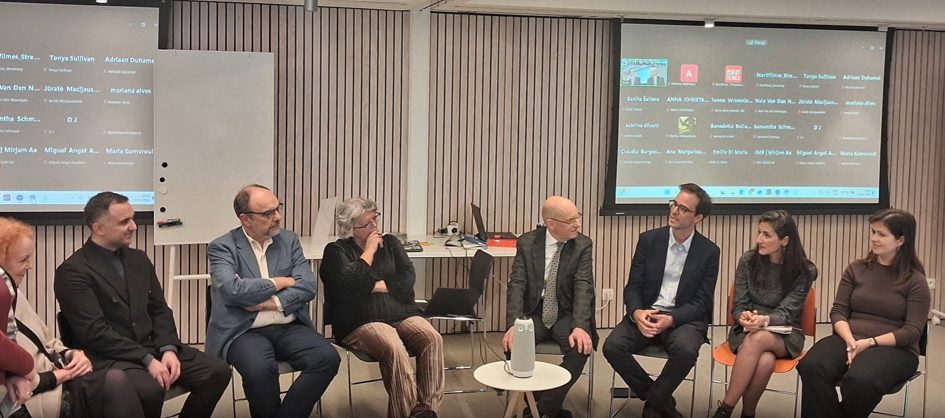
The Intergenerational Dialogues in the Geriatrics Family was undoubtedly one of the most memorable experiences of my journey within the PROGRAMMING Action.
Before the session began, I remember feeling genuinely anxious. Sitting alongside people whose work has shaped geriatric medicine in Europe, while representing the voice of Early Career Geriatricians in front of both a live and online audience, felt like a great responsibility. What I did not expect was how quickly that anxiety disappeared. The warm atmosphere and thoughtful moderation turned the session into an open, welcoming conversation rather than a formal panel discussion.
Listening to colleagues share why they chose geriatrics and the challenges they had faced was truly inspiring. Although everyone’s journey had been different, remarkable common threads emerged: a genuine commitment to responding to the needs of older adults, the intellectual challenge of managing complexity, the importance of teamwork, and the deep sense of purpose that comes from making a meaningful difference in people’s lives.
What impressed me most was the genuine curiosity from both sides and even the audience. Senior colleagues were not only sharing their experience, they were equally interested in understanding how younger colleagues perceive the future of geriatrics, the challenges we face, and the changes we hope to see. That mutual willingness to listen transformed the session into a true dialogue rather than a one-way transfer of knowledge, leaving me with a strong sense of belonging and confidence that our voices genuinely matter.
The experience reminded me that, despite our different backgrounds and career paths, we share remarkably similar values. It also showed that the future of geriatrics depends not only on scientific knowledge, but equally on mentorship, openness, mutual respect and meaningful dialogue across generations. To me, this perfectly reflects the spirit of the PROGRAMMING Action.
Serdar Ozkok:
The “Intergenerational Dialogues in the Geriatrics Family” session at the PROGRAMMING COST Action meeting in Brussels was truly a once-in-a-lifetime experience. Sharing the panel with senior colleagues whose pioneering work has shaped our field – people from whom we have learned so much through their publications and presentations, and who have genuinely inspired many of us – was an extraordinary privilege. Listening to their personal stories, experiences, and perspectives firsthand was invaluable. Equally meaningful was seeing their genuine curiosity about our own journeys and aspirations as early-career geriatricians.
It was a moment of immense pride that I will always remember, but even more importantly, it offered perspectives that cannot be found in textbooks or guidelines. I left the session inspired, motivated, and deeply grateful for the opportunity.
Reflections from participating in the webinar, workshops and contributing to the development of the Policy/Advocacy Briefs
Contributing to the development of the Policy and Advocacy Briefs has been one of the most interesting experiences of my involvement in PROGRAMMING. It was my first opportunity to participate in the co-production of policy / advocacy documents, opening up a completely new field for me.
I found it fascinating to see how recommendations intended to influence policy and practice can be developed through a structured, transparent and methodologically rigorous process, while at the same time incorporating the perspectives of a broad scientific community.
It was particularly interesting to see how the ideas shared during the webinar, together with the expertise and critical reflections of experienced geriatric professionals during the workshop, gradually evolved into the final briefs.
One aspect that particularly surprised me was how differently the value of geriatric medicine could be communicated depending on the target audience. At first, I expected the four briefs to convey largely the same messages. Instead, I realised that looking at the same field through the perspective of clinicians, policymakers, educators or the public changes not only the language, but also the priorities, the arguments and the evidence that matter most.
This highlighted for me the importance of tailoring advocacy messages if we want them to be meaningful and have real impact. Additionally, the engagement with this project improved my understanding of how research can be transformed into practical resources with real-world impact.
Maria Tampaki