PROGRAMMING Policy & Advocacy Briefs
A set of concise Policy & Advocacy Briefs developed by PROGRAMMING to communicate key messages and recommendations on the development of Geriatric Medicine education and care to different stakeholder groups.
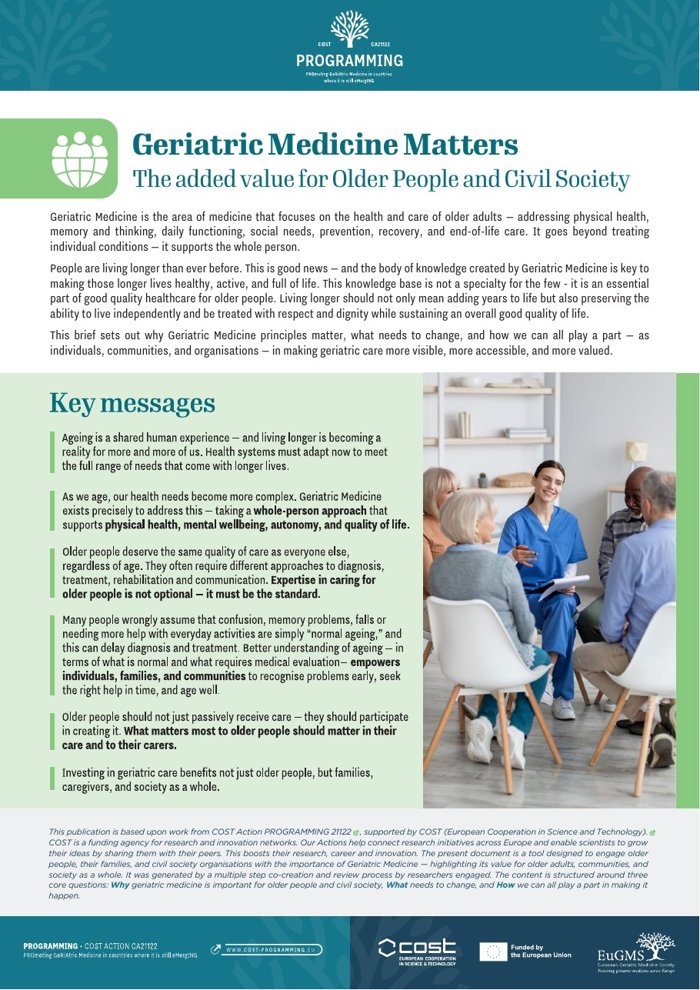
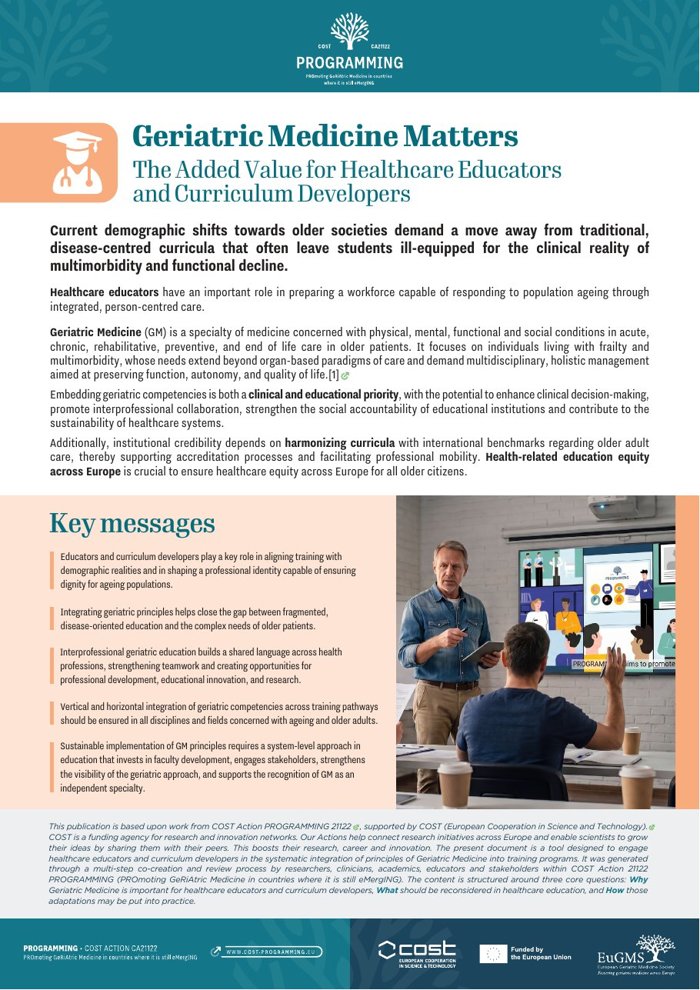
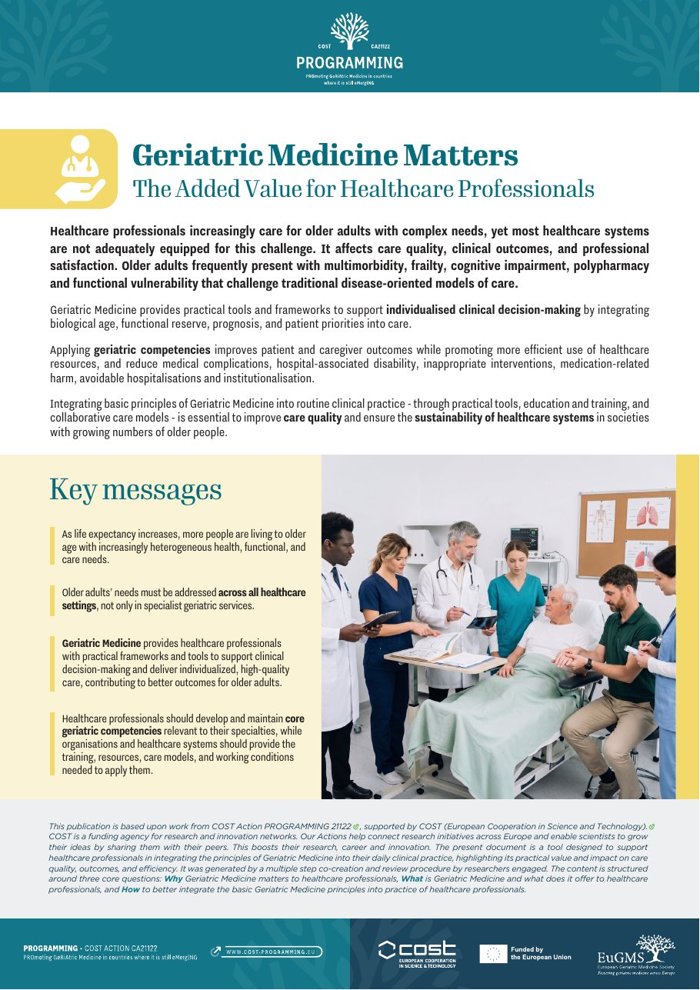
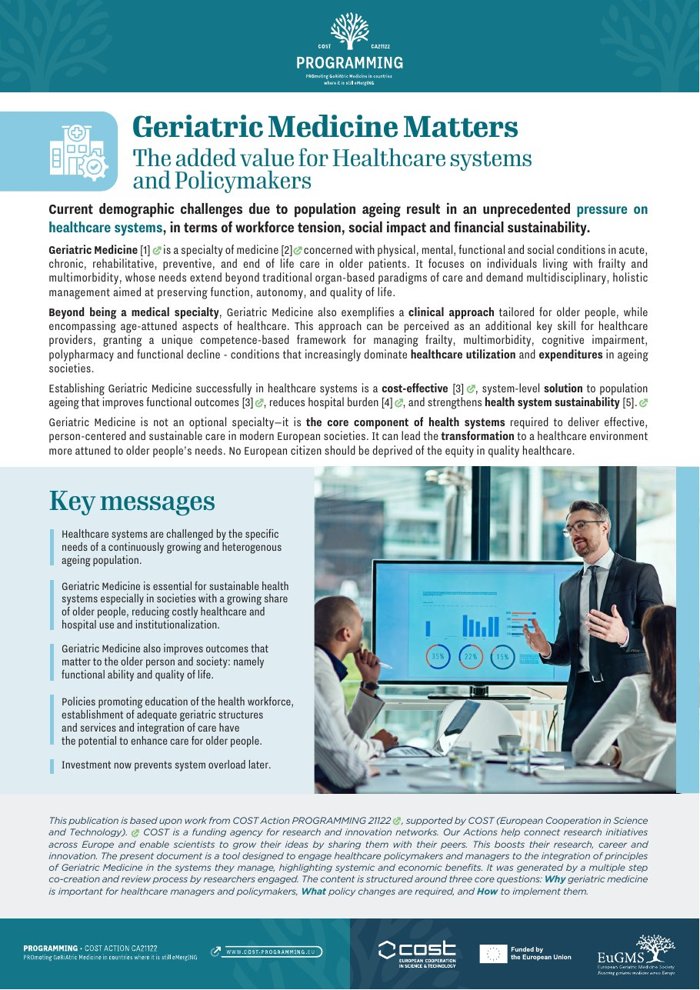
Translations
Translations of the four Advocacy Briefs are being prepared in several languages. They will be published here progressively — as each translation becomes available, a download link will replace the Coming soon label.
| Language | Brief 1 Older People & Civil Society | Brief 2 Educators & Curriculum Developers | Brief 3 Healthcare Professionals | Brief 4 Healthcare Systems & Policymakers |
|---|---|---|---|---|
| Albanian | Coming soon | Coming soon | Coming soon | Coming soon |
| Bosnian | Coming soon | Coming soon | Coming soon | Coming soon |
| Croatian | Coming soon | Coming soon | Coming soon | Coming soon |
| Danish | Coming soon | Coming soon | Coming soon | Coming soon |
| Dutch | Coming soon | Coming soon | Coming soon | Coming soon |
| Finnish | Coming soon | Coming soon | Coming soon | Coming soon |
| French | Coming soon | Coming soon | Coming soon | Coming soon |
| Greek | Coming soon | Coming soon | Coming soon | Coming soon |
| Hebrew | Coming soon | Coming soon | Coming soon | Coming soon |
| Italian | Coming soon | Coming soon | Coming soon | Coming soon |
| Macedonian | Coming soon | Coming soon | Coming soon | Coming soon |
| Portuguese | Coming soon | Coming soon | Coming soon | Coming soon |
| Romanian | Coming soon | Coming soon | Coming soon | Coming soon |
| Serbian | Coming soon | Coming soon | Coming soon | Coming soon |
| Spanish | Coming soon | Coming soon | Coming soon | Coming soon |
| Swedish | Coming soon | Coming soon | Coming soon | Coming soon |
| Turkish | Coming soon | Coming soon | Coming soon | Coming soon |
What is it?
A set of concise Policy & Advocacy Briefs developed by PROGRAMMING to communicate key messages and recommendations on the development of Geriatric Medicine education and care to different stakeholder groups.
Who is it for?
Older people and civil society; healthcare educators and curriculum developers; healthcare professionals; healthcare organisations, decision-makers and policymakers.
What can it be used for?
Advocacy, awareness-raising, stakeholder engagement, policy discussions, educational planning and communication with organisations or decision-makers involved in the development of Geriatric Medicine.
What is included?
Briefs tailored to different stakeholder audiences, together with available translated versions for use in different national and linguistic contexts.
How to use it?
Select the brief that best matches the intended audience. It can be shared directly in print or digital format, used to support meetings, advocacy activities and stakeholder engagement, or used as a reference when preparing local discussions, presentations or policy initiatives. Where translated versions are available, these may be used to facilitate dissemination and engagement in the local language and context.
Use and acknowledgement requirements
The briefs should retain acknowledgement of PROGRAMMING COST Action CA21122 and COST, together with any other credits included in the original document. When sharing or reproducing the briefs, the original source should be clearly identified.
Translation, adaptation and secondary use
Existing official translations may be freely used in accordance with the conditions indicated in the documents. New translations, substantial adaptations or use of the briefs as the basis for derivative advocacy materials should follow the agreed PROGRAMMING/EuGMS procedure and, where required, receive prior approval. Please refer to the EuGMS Global Coordinator globalcoordinator@eugms.org