Reflections on the 23rd IAGG World Congress of Gerontology and Geriatrics: A Young Researcher and Innovator Grantee’s Perspective
From 5 to 8 July 2026, I attended the 23rd IAGG World Congress of Gerontology and Geriatrics in Amsterdam, under the theme Ageing well in a globalised world. As a young geriatrician from Portugal, my participation was supported by a Young Researcher and Innovator Conference Grant from the PROmoting GeRiAtric Medicine IN countries where it is still eMerGing (PROGRAMMING) initiative.
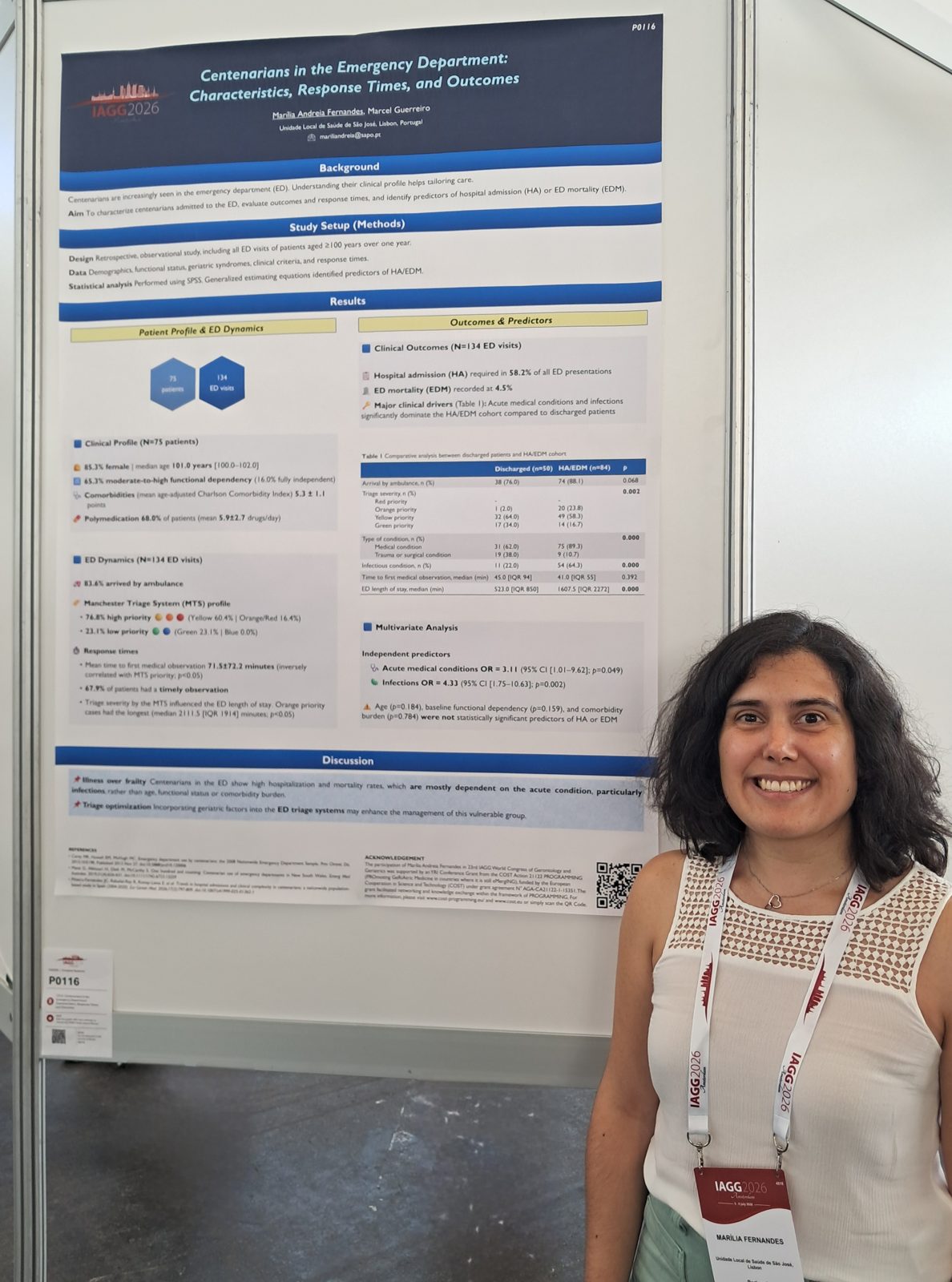
I applied for the grant with my poster Centenarians in the Emergency Department: Characteristics, Response Times, and Outcomes, a retrospective observational study of 134 emergency department (ED) visits by 75 patients aged 100 years or older. Using generalized estimating equation models, the study examined patient characteristics, response times, outcomes, and predictors of hospital admission (HA) or ED mortality (EDM). HA occurred in 58.2% of visits and EDM in 4.5%. In multivariate analysis, medical conditions (OR=3.11; 95% CI [1.01–9.62]; p=0.049) and infection (OR=4.33; 95% CI [1.75–10.63]; p=0.002) independently predicted worse outcomes. The dedicated poster presentation session enabled the dissemination of my original research on the acute care needs of centenarians while providing valuable feedback from international researchers and clinicians.
One lecture that stood out was Ageing in place in Italy in light of the current reform of long-term care services for older adults, which presented an integrated, multidimensional model linking health, social, and long-term care services. Its focus on home care, caregiver support, staff training, and case management for complex cases is particularly relevant for Portugal, which, like Italy, faces population ageing.
Reflecting my interest in pharmacology, I also valued the symposium Personalised medicine for geriatric patients: Where do we go from here?, where speakers from four continents discussed individualized medicine, medication outcomes, and key considerations such as sex and gender, falls, translational research, and big data. I was also interested in The Stroll Safe outdoor falls prevention program, presented in the symposium Falls prevention in the community; this seven-week group intervention improved knowledge of outdoor fall risk, safe strategy use, and outdoor fall self-efficacy compared with the control group. PROGRAMMING was also represented in the symposium Training in geriatric medicine with a view to a sustainable and inclusive health care system, which addressed patients’ roles, strengthening geriatric medicine where it is most needed, and attracting future doctors to the field.
Among the keynote presentations, Luigi Ferrucci’s lecture, When oxygen becomes limiting: Hypoxia as a central mechanism of biological aging, was particularly compelling. He described relative tissue hypoxia as a central, systems-level driver of biological ageing, linking molecular, physiological, and structural mechanisms across tissues.
My first World Congress of Gerontology and Geriatrics was an excellent opportunity to expand my professional network. I hope these connections will lead to valuable collaborations and help advance Geriatric Medicine in Portugal and internationally.
Marília Andreia Fernandes